

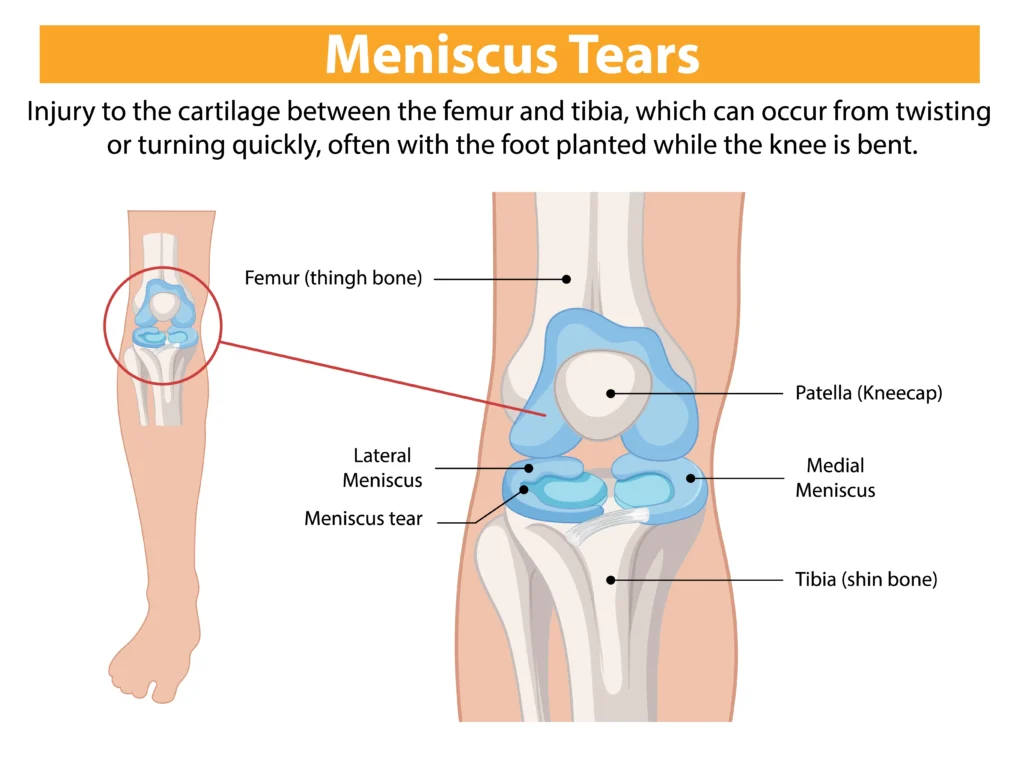
Meniscus Tears
The meniscus is a piece of cartilage that provides a cushion between your femur (thighbone) and tibia (shinbone).A meniscus is a crescent or “c”-shaped cartilage disk that’s found in the knee. There are two menisci in each knee. We have one on the inner side of the knee which we call the medial meniscus and one on the outer side of the knee which we call the lateral meniscus.
The menisci serve a very important function in the knee.
When the meniscus tears that cushioning effect functions poorly, that might lead to arthritis and knee pain.
Functions of meniscus
The meniscus functions as a cushion or shock absorber in your knee
The menisci act to redistribute the weight of the body and reduce friction during movement
Joint Lubrication
Causes of a meniscus tear:
Most commonly, a meniscus tear results from an acute injury to the knee, often from a sudden twist of the knee while squatting during a sports activity, household activities or while dancing.
Examples of sports that increase a person’s risk for a menisci tear include:
Soccer
Football
Basketball
Baseball
Skiing
Wrestling
But meniscus tears can also occur due to age-related degenerative (wear-and-tear) changes (knee osteoarthritis). As people age, their menisci weaken and become more brittle and prone to damage.Everyday movements like getting up improperly from a chair can be enough to cause a meniscus tear.
Symptoms of a meniscus tear
You might feel a “pop” when you tear a meniscus. Most people can still walk on their injured knee. Many athletes keep playing with a tear. Over 2 to 3 days, your knee will gradually become more stiff and swollen.
The most common symptoms of meniscus tear are:
Pain, Stiffness and swelling
Catching,locking or instability of your knee
You are not able to move your knee through its full range of motion
Without treatment, a piece of meniscus may come loose and drift into the joint. This can cause your knee to slip, pop, or lock.
Nonsurgical Treatment
Rest with modified activity
Apply ice or a cold pack to your knee for 15- to 20-minute sessions, 3-4 times a day.
If your tear is small and on the outer edge of the meniscus may not require surgery.
As long as your symptoms do not persist and your knee is stable, nonsurgical treatment may be all you need.
Arthroscopic surgery usually not be recommended for a degenerative meniscus tear, unless there is locking or catching of the knee, recurrent effusion or persistent pain.
Surgical Treatment (Arthroscopy)
When conservative treatment fails or patients symptoms are persistent then Arthroscopy is performed. Usually younger patients are more resilient and respond well to this treatment.
Following are two methods to improve your meniscus tear
Partial Meniscectomy – damaged part of torn meniscus is trimmed away or partially removed & leaving as much healthy meniscus as possible .In these patients in long run of 10 15 years, the chances of the knee getting wear and tear in the articular cartilage is slightly increases compared with the normal knee.
2. Meniscus repair – Some meniscus tears can be repaired by suturing (stitching) the torn pieces together. Whether a tear can be successfully treated with repair depends upon the types,location of tear, as well as the overall condition of the injured meniscus. Because the meniscus must heal back together, recovery time for a repair is much longer than from a meniscectomy.
Post-Operative Rehabilitation
After a successful surgery for treating the destroyed part of the meniscus patients must follow a rehabilitation program to have the best result. In most of the cases patient is discharged home next day ,partially weight bearing walking with the help of walker or crutches. They visit again at one week were dressing is removed and given home based physiotherapy instructions.
At 3 weeks post-surgery they are typically able to attend to 70 to 80% of normal daily activities, depending upon the procedure done at the time of surgery. At 6 weeks most of the patient are able to peruse their 95% of normal activities and are able to drive car and two wheelers. They are given specific restrictions depending upon their pathology found at the time of surgery.
Results
Meniscus repair is highly successful , with good results in approximately 90% of patients. Any knee that is injured has a higher likelihood of developing arthritis. A successful repair slows the development of arthritic changes. Factors associated with higher rates of meniscus healing include repair within 2 months, more peripheral tear location, and concomitant ACL reconstruction.