

Anterior Cruciate Ligament (ACL)
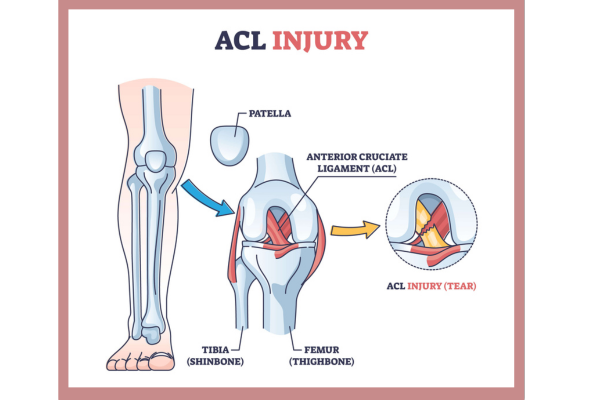
The anterior cruciate ligament is a band of tissue within the knee jt. ACL connect femur to tibia The anterior cruciate ligament runs diagonally in the middle of the knee.
ACL consists of two bundles
Anteromedial (AM) bundle – which inserts more towards the front and towards the inside of the leg bone (tibia).
Posterolateral (PL) bundle- inserts most towards the back and towards the outside of the tibia.
Function of ACL ??
The ACL provides stability to the knee, while also allowing for normal knee movement. It prevents the tibia from sliding out in front of the femur, as well as provides rotational stability to the knee. The cruciate ligaments control the back and forth motion of your knee
Cause of ACL injury ??
ACL tears are very common. The highest occurrence is in individuals between 15 to 25 years of age who participate in pivoting and cutting sports. However, ACL tears can occur at all ages and most commonly occur during sports that involve sudden stops or changes in direction, jumping and landing — such as soccer, basketball, football and downhill skiing. Usually an ACL tear occurs during sporting activities, two wheeler vehicular accident or may be in domestic accidents.
Symptoms
Patients frequently report “hearing a pop” at the time of injury and often have large swelling and pain soon after, in the injured knee
Sometimes in day to day activities patient with torn ACL experience frequent “giving Way” (Subluxate) leading to periodic increase in the pain in the injured knee.
They feel less confident on their injured knee in brisk walking, walking on uneven surface, walking on wet or slippery surfaces.
They are uncomfortable in Jumping down from the small height like few steps and not willing to run/jog even for small distances.
If they have been having meniscus tear with the ACL tear they can experience episodes of ”locking of knee” (not able to move knee joint) lasting from few minutes to few hours to few days.
In short patients of ACL are otherwise able to lead near normal life with significant restrictions.
How is an ACL tear diagnosed?
This is done through a thorough history of your injury as well as through a variety of physical exams.The physical examination in clinic is used to make the provisional diagnosis.
MRI scans are used to image the ACL, confirm the diagnosis and evaluate for other possible injuries, like meniscus tears & cartilage injury.
I also take x-rays of the knee. You cannot see the ACL on x-ray, but I do this to make sure there is no problem with the bones, such as a fracture.
When ACL is torn, does it heal naturally?
No, it does not heal. This ligament mostly being made of fibres like elastic tissue, both ends of the torn ligament move away from each other gradually and eventually there will be empty space between two torn ends which cannot bridge naturally leaving it unhealed.
My ACL is torn, do I absolutely need surgery?
surgical intervention varies from patient to patient and depends on the patient’s activity level, degree of injury and instability symptoms. partially torn ACL The prognosis for a is often favourable, with the recovery and rehabilitation period usually at least 3 months. However, some patients with partial ACL tears may still have instability symptoms.
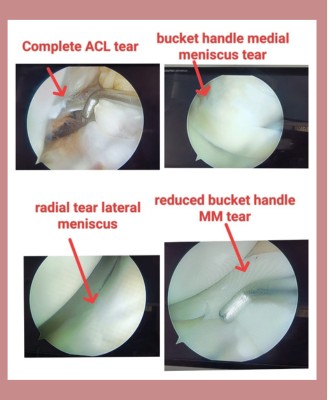
Complete ACL ruptures have a much less favourable outcome without surgical intervention.
There are some middle to old aged patients who are able to function without an intact ACL. These patients modify their lifestyle by eliminating aggressive normal activities that require pivoting and cutting. However, sometimes during everyday activities the ACL-deficient knee can buckle or “give way” (Subluxate) resulting in painful episodes with swelling. In short one has to restrict the life significantly so as to not provoke the episode of the giving way. Importantly, there is a risk of damage to the menisci (the cartilage shock absorbers) and articular cartilage (the slippery gliding surface on the ends of the bones) with each subluxation event. This damage can lead to degenerative arthritis and subsequent meniscus tears. These tear of meniscus and damage to articular cartilage is largely irrecoverable even when patient opt for surgery at the later date. Because of these concerns a majority of active and young patients elect to undergo ACL surgery when the ligament tears.
I just tore my ACL—when will I be ready for surgery?
In general, there are few criteria that must be met before the ACL can be surgically reconstructed:
- Swelling in the knee must go down to near-normal levels
- Range-of-motion (bending and straightening) of the injured knee must be nearly 50% of the uninjured knee.
- Good Quadriceps muscle strength must be present. This means that while lying flat on your back you should be able to raise your leg off the ground while holding it is straight. I call this a “straight leg raise”.
Usually it takes a few weeks after injury before ACL reconstruction can be performed. The mode of injury like domestic accident or vehicular accident. The velocity of the injury low, moderate or high velocity also play big role in the decision. The presence of any associated injuries to the knee joint involving cartilage, Contusion of the marrow, meniscus, or other ligaments may change the time-frame for surgery.
Can My ACL Be Repaired ?
yes, recently trend and new technique of ACL repair is being performed in the very few selected suitable cases. ACL repair is typically being performed in relatively fresh ACL injuries of femoral end avulsion cases in young individuals. However final decision of repair versus reconstruction will be taken by your doctor only during the surgery.
What Happens During the Operation?
The surgical procedure itself takes between 60 and 90 minutes. You will be in the operating room between 90 and 120 minutes. To reconstruct the ACL, you are given general anaesthesia/spinal anaesthesia and arthroscopy is performed.
We replace the torn ligament with new tissue (Tendon) from your knee. The purpose is to stabilise the knee joint and give it the full range of movement and motion.
ACL reconstruction procedure
Diagnostic Arthroscopy -it’s a first step of ACL surgery. This means I look inside the joint with a scope using small punctures and very small delicate instrumentation. I look carefully at the injured ACL & determine where and how it is torn. It can be partially or completely torn. An Other associated injuries like meniscus tear & cartilage damage can be deal this time.
Graft harvesting
The graft tissue comes from your own body (autograft) Autograft options include different tendons from different muscles: Hamstrings Tendons, Quadriceps Tendon, and Patellar Tendon (BTB), peroneus longus tendon, hamstring tendon from opposite knee. Usually we harvest hamstrings tendons from same operating knee. Preparing the graft & make it four ,five or six strands according to need.
Tunnel placement –with the help of special instruments tunnel is drilled in the bone according to the size and length of the graft then
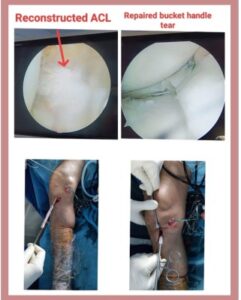
Passage of graft & fixation – ACL graft is passed into the tunnels and fixed to the femur and tibia bones with a combination of special buttons, screws and sometimes with staples depending upon the need condition of the bone and graft. In general, most techniques utilise specially designed screws allowing secure immediate fixation of the graft material within bone tunnels drilled into the knee.
These fixation options are discussed with you explaining the pros and cons of each fixation option.
What time does It take for recovery after an ACL reconstruction surgery:
Rehabilitation guidelines may change depending on each patient. Your doctors may tailor a specific, individualized rehabilitation program depending on the number of surgeries you have had, accompanying ligament and meniscal injuries, your individual progress, and other factors that may impact the healing of your graft. Almost patients achieve excellent range-of-motion by 6-8wk equal to the other knee. stair climbing, walking outdoors without stick, attending table work & driving 4 wheeler by 6 weeks can be permitted guidelines should be followed closely because the new ACL needs time to heal. Remember, returning to sports before the graft is healed increases the chances of re-injury. Although you may feel “fine” earlier, the ACL graft takes about 6-9 months to heal.
ACL ReconstructionSurgery in Kota
Specialist evaluation and individualized treatment for ACL tears, knee instability, meniscus injuries and sports-related knee problems at Durva Hospital.
The Ligament That Keeps Your Knee Stable
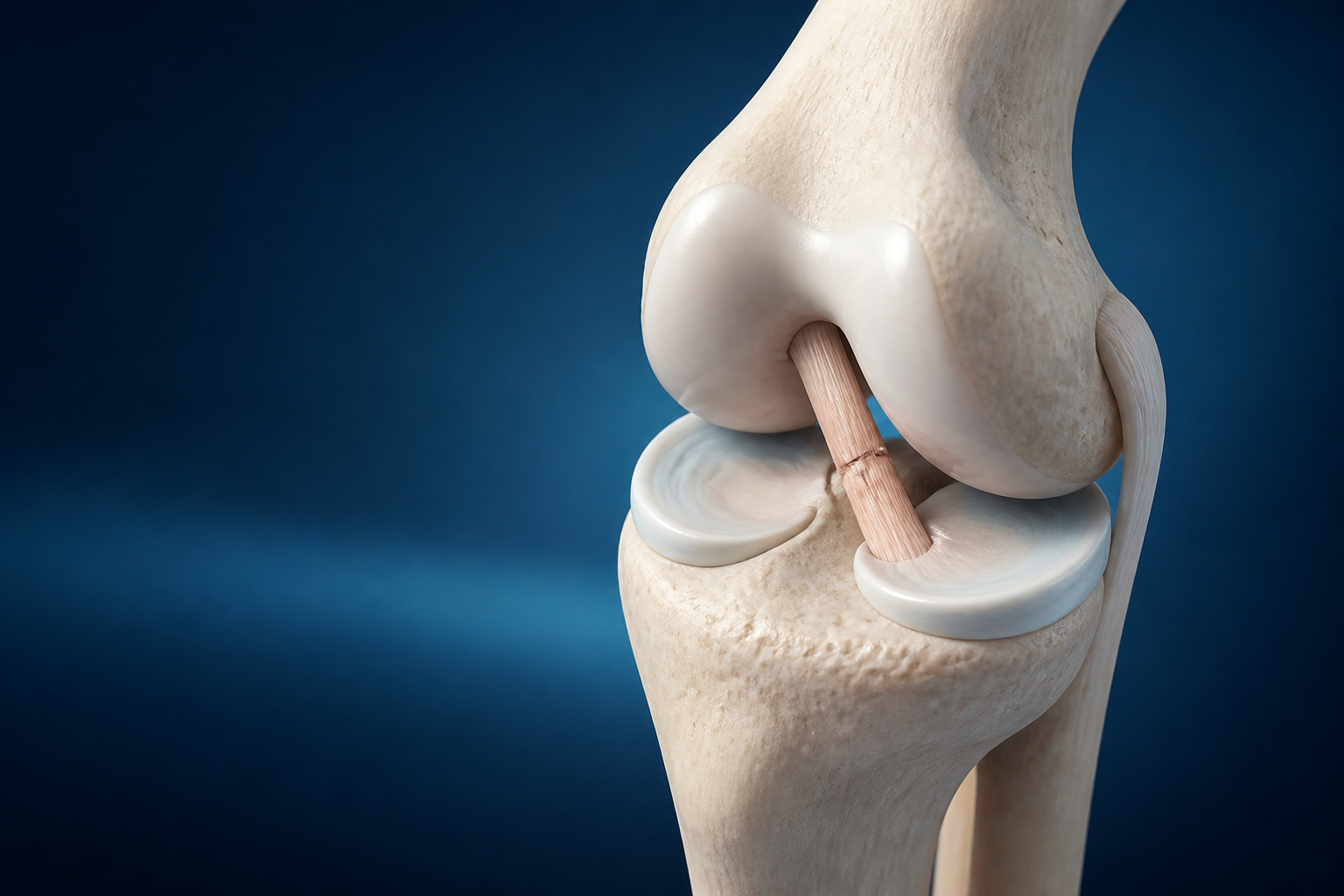
The Anterior Cruciate Ligament is a strong band of connective tissue inside the knee. It runs diagonally through the joint and connects the femur (thigh bone) to the tibia (shin bone).
It helps control forward movement and rotation of the knee during walking, running, jumping, landing and sudden changes in direction.
Anteromedial Bundle
Contributes significantly to controlling forward movement of the tibia.
Posterolateral Bundle
Contributes importantly to rotational stability of the knee.
Stability for Everyday Movement and Sport
When the ACL is torn, the knee may become unstable during pivoting, running, uneven surfaces or sudden changes in direction.
Controls Forward Movement
Helps prevent excessive forward movement of the tibia relative to the femur.
Controls Rotation
Supports rotational stability during turning, pivoting and changing direction.
Supports Performance
Helps stabilize the knee during running, jumping, landing and sports activities.
How ACL Injuries Happen
ACL injuries frequently occur during sudden stopping, twisting, changing direction or awkward landing. They can also follow road accidents, two-wheeler accidents, falls and domestic injuries.
Signs of an ACL Tear
Accurate Evaluation Before Treatment
Diagnosis begins with a detailed history and physical examination. The doctor assesses swelling, movement, knee stability and possible associated injuries.
Clinical Examination
Specific stability tests, range-of-motion assessment and evaluation of pain and swelling.
MRI Scan
Helps assess the ACL and associated meniscus, cartilage, ligament, bone-bruise and soft-tissue injuries.
X-Ray
Helps evaluate bones, fractures, alignment problems and other bony abnormalities.
Does Every ACL Tear Need Surgery?
No. Treatment depends on whether the tear is partial or complete, knee instability, age, activity level, sporting needs, associated injuries and personal expectations.
How the Procedure Is Planned
At Durva Hospital, ACL reconstruction is performed using arthroscopic techniques when clinically appropriate. The exact technique and graft choice are individualized.
Diagnostic Arthroscopy
The ACL, meniscus, cartilage, ligaments and joint surfaces are examined through small incisions.
Graft Selection
Hamstring, quadriceps, patellar or another suitable tendon graft may be selected.
Graft Preparation
The selected tendon is prepared to the size and configuration required for the technique.
Tunnel Placement
Femoral and tibial tunnels are created at appropriate anatomical positions.
Passage & Fixation
The graft is passed through the tunnels and securely fixed to the femur and tibia.

Detailed Evaluation. Individual Surgical Planning.
Dr. Hitesh Mangal is an orthopedic surgeon in Kota with a clinical focus on arthroscopy, sports injuries and joint replacement. His listed expertise includes ACL/PCL injuries, meniscus injuries, cartilage damage and complex knee and shoulder sports injuries.
Progressive Recovery, Guided by Function
Recovery varies with graft choice, surgical technique, associated injuries, strength, knee movement, healing response and rehabilitation progress.
Control & Movement
Focus on swelling control, knee movement and safe early mobility according to the prescribed protocol.
Strength
Progressive work on quadriceps, hamstrings and overall lower-limb strength.
Control & Function
Balance, coordination, neuromuscular control and functional movement training.
Testing & Readiness
Return is based on stability, motion, strength, performance and psychological readiness—not only time.
ACL Reconstruction FAQs
Is ACL surgery painful?
ACL reconstruction is performed under anesthesia. Pain and swelling can occur afterward, but appropriate pain management and rehabilitation are used during recovery.
How long does ACL reconstruction surgery take?
The duration depends on the individual case, surgical technique and whether associated injuries such as a meniscus tear require treatment.
Can I walk after ACL surgery?
Walking progression depends on the procedure, associated injuries and the rehabilitation protocol prescribed by the surgeon.
When can I drive after ACL reconstruction?
Driving should resume only when adequate control, mobility and strength have returned and the treating doctor has given clearance.
Can I return to sports after ACL surgery?
Many patients can return after appropriate rehabilitation. Return should be based on functional recovery and medical clearance rather than only a fixed number of months.
Is every ACL tear treated with reconstruction?
No. Some patients may be appropriate for rehabilitation or, in selected cases, ACL repair. Treatment is individualized.
Don’t Ignore Repeated Knee “Giving Way”
Early orthopedic evaluation can help identify ACL, meniscus and associated knee injuries and guide an appropriate treatment plan.